






The question “How many people fail in NECO 2025?” is one of the most searched education-related queries in Nigeria right now. Students preparing for the examination, parents funding the process, school owners, and even employers are all asking the same thing. Everyone wants clarity. Everyone wants numbers. Everyone wants to know what to expect.
This article answers how many people fail in NECO 2025 using available examination patterns, historical NECO performance data, emerging educational realities, and expert interpretation. Because NECO 2025 results are not released at the time of writing, this analysis does not invent figures. Instead, it explains what failure usually looks like in NECO, why it happens, how many candidates are affected in a typical year, and what the likely outcome for NECO 2025 will be based on trends.
This is not guesswork. It is a careful, data-guided explanation written in clear language for students, parents, teachers, and policymakers.
Understanding NECO and What “Failure” Really Means
Before asking how many people fail in NECO 2025, it is important to understand what failure actually means in the context of NECO.
NECO does not publish results using the word fail or pass officially. Instead, candidates receive grades ranging from A1 to F9 across subjects.
In practical terms, failure in NECO usually refers to:
- Not having at least five credits, including English Language and Mathematics
- Scoring D7, E8, or F9 in core subjects
- Being unable to meet admission or employment requirements
So when Nigerians ask how many people fail in NECO 2025, what they truly mean is:
How many candidates are likely not to obtain the minimum credits required for further education or job opportunities?
How Many Candidates Usually Sit for NECO Each Year
To understand how many people fail in NECO 2025, we must first look at the average number of candidates who register for NECO annually.
In recent years:
- NECO candidates typically range between 1.2 million and 1.4 million
- This includes candidates from public schools, private schools, and external (private) candidates
NECO has become increasingly popular because:
- It is often perceived as more flexible than WAEC
- Some candidates sit NECO as a backup examination
- Schools with weaker WAEC performance sometimes prefer NECO
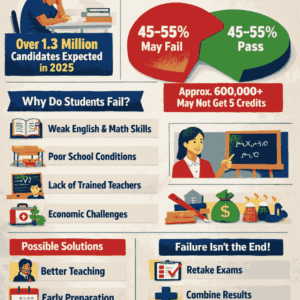
Given population growth and rising school enrolment, NECO 2025 is expected to record over 1.3 million candidates nationwide.
Historical NECO Performance: How Many People Fail in a Typical Year
Since NECO does not publish a single national “failure rate,” performance is assessed based on the percentage of candidates who obtain five credits including English and Mathematics.
Over the past decade, NECO performance has followed this general pattern:
- 40% – 55% of candidates obtain five credits including English and Mathematics
- 45% – 60% do not meet that requirement
This means that in an average year:
- Between 500,000 and 800,000 candidates struggle to meet full credit requirements
So when people ask how many people fail in NECO 2025, historical data suggests that nearly half of all candidates may not meet the standard benchmark.
Projected Failure Rate for NECO 2025
Based on:
- Past NECO trends
- Quality of secondary education in Nigeria
- Ongoing challenges in public schools
- Teacher shortages
- Learning gaps caused by economic hardship
It is reasonable to project that in NECO 2025:
- 45% to 55% of candidates may not achieve five credits including English and Mathematics
If 1.3 million candidates sit for NECO 2025, this projection suggests that:
- Between 585,000 and 715,000 candidates may fall short of the required benchmark
This does not mean all these candidates completely failed. Many will pass several subjects but still lack one or two key credits.
Why Many Students Fail NECO Every Year
To fully answer how many people fail in NECO 2025, we must address why failure remains high.
1. Weak Foundation in English and Mathematics
English Language and Mathematics are compulsory. A candidate may pass six subjects but still be considered unsuccessful if these two are missing.
Common issues include:
- Poor reading comprehension
- Weak grammar and vocabulary
- Fear of Mathematics
- Inadequate problem-solving skills
These weaknesses often begin in primary school and remain unresolved.
2. Poor Learning Environment in Public Schools
Many public secondary schools struggle with:
- Overcrowded classrooms
- Insufficient textbooks
- Broken desks and infrastructure
- Lack of laboratories
Students preparing under such conditions are at a disadvantage compared to their peers in well-funded private schools.
3. Inadequate Teacher Motivation and Training
Teacher quality directly affects NECO performance.
Problems include:
- Low salaries
- Irregular training
- Teacher shortages in science subjects
- Heavy workload
When teachers are overwhelmed or demoralized, students suffer academically.
4. Over-Reliance on Examination Malpractice
Some students rely on cheating instead of preparation.
When:
- Exam supervision is tight
- Malpractice fails
- Questions differ from expectations
Such candidates often perform poorly. Ironically, fear of NECO is sometimes greater among students who did not prepare genuinely.
5. Economic Pressure on Students
Many NECO candidates:
- Combine school with trading or work
- Miss classes due to financial hardship
- Lack access to tutorials
Economic stress affects concentration, study time, and overall academic performance.
Is NECO Harder Than WAEC?
A common follow-up to how many people fail in NECO 2025 is whether NECO is harder than WAEC.
The honest answer is:
- NECO is not harder, but it is different
NECO questions often:
- Focus more on syllabus coverage
- Reward direct understanding rather than rote memorization
- Require clear expression, especially in English
Students who rely only on cramming past questions often struggle.
Does Failing NECO Mean the End of the Road?
One reason the question how many people fail in NECO 2025 causes anxiety is the fear of finality. But failure in NECO is not the end.
Options include:
- Re-sitting NECO or WAEC
- Using NABTEB results
- Combining results (where accepted)
- Exploring vocational and technical education
Many successful Nigerians today once failed NECO or WAEC but later recovered.
How Schools Can Reduce NECO Failure Rate
To reduce how many people fail in NECO 2025 and beyond, schools must:
- Strengthen English and Mathematics teaching
- Begin NECO preparation early (SS1–SS3)
- Conduct regular mock examinations
- Focus on concept understanding, not shortcuts
How Students Can Avoid Failing NECO 2025
Students preparing for NECO 2025 should:
- Study the NECO syllabus carefully
- Practice past questions with understanding
- Improve reading and writing skills daily
- Seek help early in weak subjects
- Avoid dependence on “expo”
Consistent effort matters more than last-minute panic.
Parents’ Role in NECO Success
Parents influence whether their children pass or fail NECO.
Support includes:
- Providing basic study materials
- Monitoring school attendance
- Encouraging discipline at home
- Avoiding pressure that causes anxiety
When parents are involved, performance improves.
What NECO Failure Statistics Say About Nigerian Education
The recurring question how many people fail in NECO 2025 reveals deeper systemic issues:
- Inequality between private and public education
- Poor funding of schools
- Inconsistent education policies
Until these are addressed, NECO failure rates will remain high.
Final Verdict: How Many People Fail in NECO 2025?
While exact figures will only be known after results are released, evidence strongly suggests that:
- Nearly half of NECO 2025 candidates may not obtain five credits including English and Mathematics
- This could affect over 600,000 students nationwide
However, failure is not permanent. NECO is a checkpoint, not a dead end.
Conclusion
The question how many people fail in NECO 2025 is not just about numbers. It reflects fear, hope, pressure, and the reality of Nigeria’s education system. Failure in NECO remains significant, but it is also preventable.
With better preparation, honest study, supportive teaching, and parental involvement, many candidates who would have failed can still succeed.
NECO does not define intelligence. It only measures readiness at a particular moment.
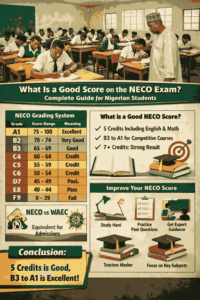
Also Read: What Is a Good Score on the NECO Exam? A Complete Guide for Nigerian Students
FAQs
1. Has NECO released the official failure rate for 2025?
No. At the time of writing, NECO 2025 results have not been officially released. Any figures discussed are projections based on past trends.
2. Can someone still succeed in life after failing NECO?
Yes. Many people retake the exam, combine results, or pursue vocational and professional paths successfully.
3. Is NECO easier than WAEC?
NECO is not necessarily easier; it simply tests understanding differently. Proper preparation is what determines success, not the exam body.













+ There are no comments
Add yours