





If you are preparing for the West African Senior School Certificate Examination, one common question students ask is: “Are 7 subjects allowed in WAEC?” Many candidates worry about whether registering 7 subjects in WAEC is acceptable or if they must take more subjects to meet admission requirements.
The short answer is yes, 7 subjects are allowed in WAEC, but there are important conditions attached to this. Universities, polytechnics, and colleges of education in Nigeria usually require a specific combination of subjects for admission. Because of this, understanding whether 7 subjects are allowed in WAEC and how it affects admission is extremely important for every candidate.
In this detailed guide, you will learn everything you need to know about are 7 subjects allowed in WAEC, including official WAEC rules, subject requirements, university expectations, and practical advice for students preparing for the exam.
Understanding WAEC Subject Requirements
Before answering the question “are 7 subjects allowed in WAEC”, it is important to understand how the examination body structures its subjects.
The West African Examinations Council (WAEC) organizes the West African Senior School Certificate Examination (WASSCE) for students across West Africa, including Nigeria, Ghana, Sierra Leone, Liberia, and The Gambia.
You can visit the official WAEC website here:
https://www.waecnigeria.org
In Nigeria, students typically sit for WAEC in SS3, and the subjects they register usually depend on their academic track:
- Science
- Commercial
- Arts
Most schools register students for 8 or 9 subjects, but this does not automatically mean that registering fewer subjects is prohibited.
This leads back to the important question: are 7 subjects allowed in WAEC?
The answer depends on WAEC registration rules and admission requirements of tertiary institutions.
Are 7 Subjects Allowed in WAEC?
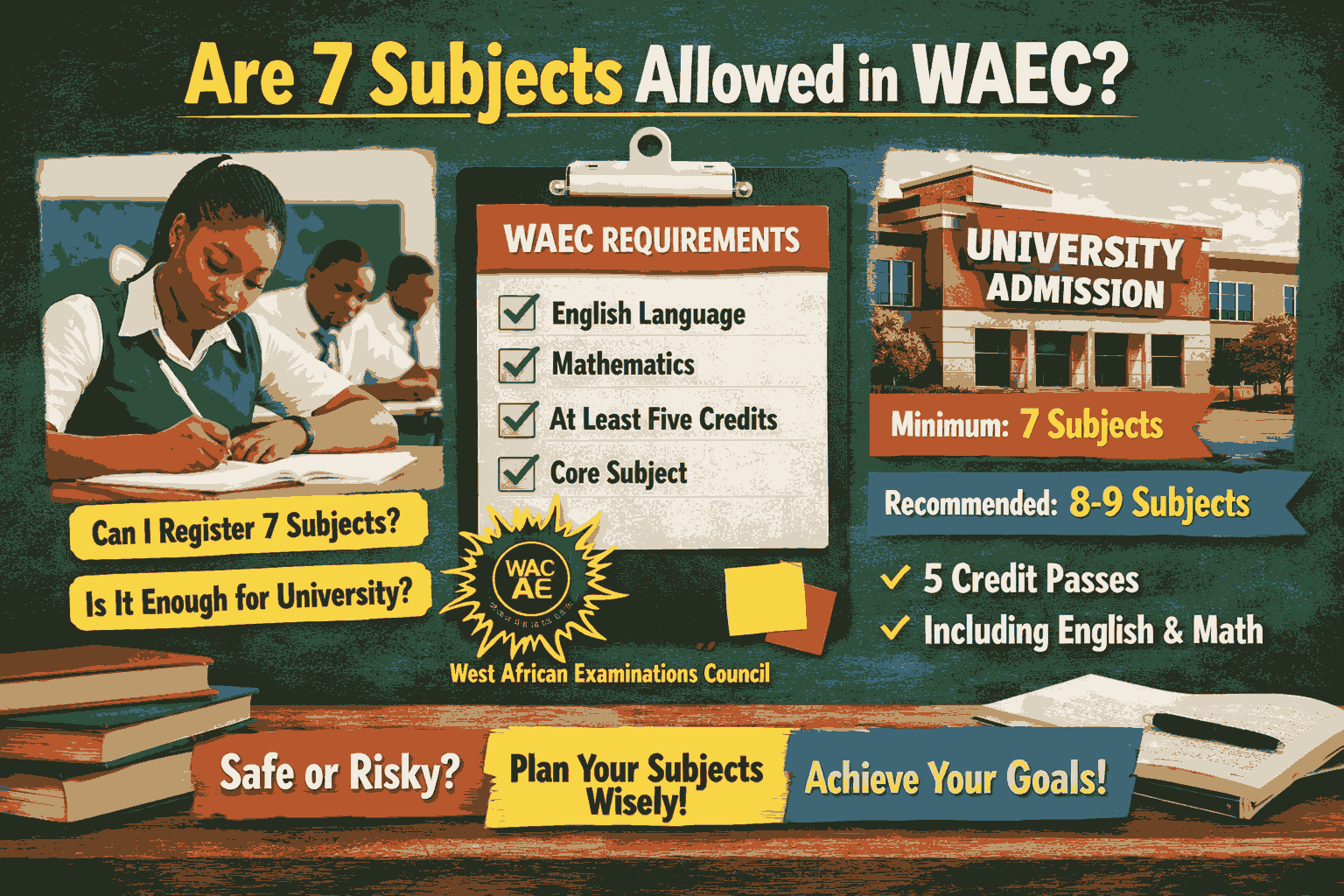
Yes, 7 subjects are allowed in WAEC, but it is not the most common registration pattern.
WAEC itself does not strictly forbid candidates from sitting for 7 subjects, provided the subjects include the core compulsory ones required for the certificate.
The compulsory subjects typically include:
- English Language
- Mathematics
- Civic Education
- One major subject related to your field (Science, Arts, or Commercial)
However, even though 7 subjects are allowed in WAEC, most schools still encourage students to register 8 or 9 subjects for safety.
This is because university admission requirements in Nigeria usually demand at least five credit passes, including English and Mathematics.
If a student writes only 7 subjects in WAEC and fails one or two, it may reduce the chances of meeting admission requirements.
So while the answer to are 7 subjects allowed in WAEC is yes, it may not always be the safest option.
Minimum Number of Subjects Required in WAEC
To better understand are 7 subjects allowed in WAEC, it helps to know the minimum number of subjects required for the examination.
WAEC regulations generally allow candidates to register between 7 and 9 subjects.
Typical registration structure:
- Minimum: 7 subjects
- Common practice: 8 or 9 subjects
This means that technically, 7 subjects are allowed in WAEC and candidates can obtain a valid certificate with that number.
However, educational institutions often advise students to choose more than 7 subjects because:
- It increases chances of obtaining five credits.
- It provides alternative subjects if one is failed.
- Some courses require specific subject combinations.
Because of these factors, many students still ask are 7 subjects allowed in WAEC before deciding on their subject registration.
Why Most Schools Register Students for 8 or 9 Subjects
Although 7 subjects are allowed in WAEC, most secondary schools in Nigeria prefer registering students for 8 or 9 subjects.
There are several reasons for this practice.
1. Higher Chance of Passing Required Subjects
Admission into universities requires five credit passes.
If a student registers only 7 subjects in WAEC and fails two subjects, the candidate may end up with only five passes without the required combinations.
By registering more subjects, students increase their chances of success.
2. Flexibility for University Courses
Some courses require specific subject combinations.
For example:
Engineering
- English
- Mathematics
- Physics
- Chemistry
Law
- English
- Literature
- Government
Because of these combinations, schools often include extra subjects.
3. Backup Subjects
Even though 7 subjects are allowed in WAEC, additional subjects serve as a safety net if some subjects are failed.
WAEC Subject Combination Examples
Understanding subject combinations also helps clarify are 7 subjects allowed in WAEC.
Below are examples of subject combinations students may register.
Science Students
Typical subjects:
- English Language
- Mathematics
- Physics
- Chemistry
- Biology
- Civic Education
- Further Mathematics
- Geography or Agricultural Science
Even though 7 subjects are allowed in WAEC, science students often register 8 or 9 subjects.
Commercial Students
Common subjects include:
- English Language
- Mathematics
- Economics
- Commerce
- Accounting
- Civic Education
- Government
- Financial Accounting
Again, while 7 subjects are allowed in WAEC, most commercial students sit for more subjects.
Arts Students
Typical subjects include:
- English Language
- Mathematics
- Literature in English
- Government
- Christian Religious Studies or Islamic Studies
- Civic Education
- History
- Economics
Can You Gain Admission with 7 WAEC Subjects?
Another major concern related to are 7 subjects allowed in WAEC is whether admission into tertiary institutions is possible with that number.
The truth is that admission depends on credit passes, not the total number of subjects written.
Most universities require:
- Five credit passes
- Including English and Mathematics
This means that if a student writes 7 subjects in WAEC and obtains five relevant credits, admission is still possible.
However, if a student writes 7 subjects in WAEC and fails two key subjects, admission may become difficult.
That is why guidance counselors often advise students not to rely on the minimum number of subjects.
Difference Between WAEC Internal and WAEC Private Candidates
To fully understand are 7 subjects allowed in WAEC, it is also important to know the difference between two major WAEC categories.
WAEC for School Candidates
Also called May/June WAEC.
Students write this exam through their schools, and schools usually decide the number of subjects.
Most schools register students for 8 or 9 subjects, even though 7 subjects are allowed in WAEC.
WAEC Private Candidates (GCE)
Also called WAEC GCE.
Candidates register individually and can choose their subjects more freely.
Some candidates register only the subjects they want to improve.
More information about WAEC GCE is available here:
https://registration.waecdirect.org
Advantages of Registering More Than 7 Subjects
Although 7 subjects are allowed in WAEC, registering more subjects has several advantages.
Better Admission Chances
More subjects increase the possibility of getting the required credits.
Alternative Subject Options
If one subject is failed, another subject can replace it.
Competitive Advantage
Some universities consider strong results across many subjects.
Flexibility for Course Changes
Students sometimes change their preferred courses after WAEC.
Extra subjects help maintain eligibility.
Common Mistakes WAEC Candidates Make
When discussing are 7 subjects allowed in WAEC, it is important to mention common mistakes students make.
Choosing Too Few Subjects
Many students rely on the minimum requirement and later regret it.
Ignoring Subject Combination
Universities may reject results that do not match course requirements.
Poor Registration Guidance
Some students choose subjects without consulting teachers or counselors.
Avoiding these mistakes can greatly improve success in WAEC.
Tips for Choosing the Right WAEC Subjects
Even though 7 subjects are allowed in WAEC, choosing the right subjects is more important than simply counting the number.
Here are useful tips.
Know Your Intended Course
Check the subject requirements for your intended university course.
You can verify admission requirements through the Joint Admissions and Matriculation Board (JAMB) website:
https://www.jamb.gov.ng
Speak With Teachers
Teachers often understand subject combinations better.
Choose Subjects You Can Pass
Do not select subjects only because others are choosing them.
Conclusion
The question “are 7 subjects allowed in WAEC” is very common among Nigerian secondary school students. The correct answer is yes, 7 subjects are allowed in WAEC, and candidates can obtain a valid certificate with that number of subjects.
However, although 7 subjects are allowed in WAEC, most schools recommend registering 8 or 9 subjects. This provides extra protection in case a candidate fails one or two subjects and increases the chances of meeting university admission requirements.
Ultimately, success in WAEC depends more on passing the right subjects with credit grades rather than simply focusing on the number of subjects written.
Students should therefore plan their subject combination carefully, seek guidance from teachers, and aim for strong performance in all registered subjects.
Also Read: Which Novel Is WAEC Using for 2026? (Complete WAEC Literature Texts for 2026–2030)
FAQs
1. Are 7 subjects allowed in WAEC?
Yes, 7 subjects are allowed in WAEC. However, most schools register students for 8 or 9 subjects to improve their chances of obtaining the required credits.
2. Can I enter university with 7 WAEC subjects?
Yes, it is possible if you obtain five credit passes, including English and Mathematics, and the subjects match your course requirements.
3. What is the maximum number of subjects in WAEC?
Most candidates register 8 or 9 subjects, although WAEC allows a minimum of 7 subjects.












+ There are no comments
Add yours